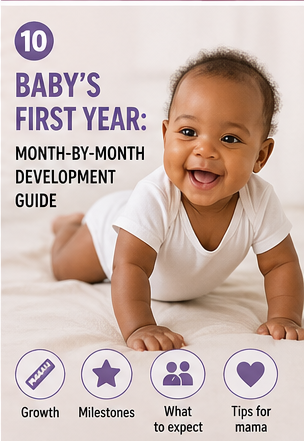
Your baby’s first year is the most extraordinary period of human development. In just 12 months, a helpless newborn transforms into a walking, talking (almost!), laughing, curious little person. Here is what to expect — and how to support your Nigerian baby every step of the way.
Month 1-2: The Newborn Phase
Baby can see about 20-30cm away — perfectly calibrated to see your face while feeding. Babies at this stage love hearing your voice. Talk, sing, pray out loud — any Nigerian language works beautifully! Developmental focus: tummy time (at least 3-5 minutes, several times a day) to build neck and shoulder strength.
Tip: MamaCare.ng’s Tummy Time Mat with black and white patterns stimulates early visual development in Nigerian newborns!
Month 3-4: Social Smiles Begin!
This is when it gets really magical. Baby starts smiling in response to you. They can hold their head up during tummy time. Babies at this stage love sounds — rattles, your singing, even Fuji music! Cooing and talking back to you begins.
Month 5-6: Sitting and Solids Time
Baby begins to sit with support and may roll over. Around 6 months, most babies are ready to start solid foods alongside breast milk or formula. In Nigeria, this is often when families introduce ogi (pap), pureed vegetables, or baby rice cereal. Always introduce one new food at a time and wait 3-4 days before introducing another.
Remember: No salt, no sugar, no honey, and no cow’s milk as a main drink before 12 months.
Tip: MamaCare.ng stocks a full range of Stage 1 baby foods, feeding spoons, suction bowls, and bibs — everything for your baby’s weaning journey!
Month 7-8: Crawling and Stranger Anxiety
Baby may start crawling (or commando-crawling — all normal!). Stranger anxiety is common now — baby may cry when held by unfamiliar faces, including those aunties who have not visited in a while! This is developmentally healthy.
Month 9-10: Pulling Up and First Words
Baby begins pulling to stand using furniture. First recognisable sounds emerge: mama, dada, baba. In multilingual Nigerian homes, babies absorb all languages being spoken — this is a cognitive superpower! Keep speaking to baby in Yoruba, Igbo, Hausa, or your mother tongue alongside English.
Month 11-12: First Steps and First Birthday!
Most babies take their first independent steps between 9-12 months (some later — up to 18 months is still normal). Baby now understands simple instructions, may have a few words, feeds themselves finger foods, and has gone from total dependence to remarkable independence.
When to Speak to Your Paediatrician
Every child develops at their own pace, but consult your doctor if by 6 months baby shows no social smiling; by 9 months no babbling or pointing; by 12 months no single words; or any loss of skills already achieved.
Supporting Your Baby’s Development the Nigerian Way
Skin-to-skin contact, babywearing, talking and singing in your mother tongue, exposing baby to extended family, and the natural sensory richness of Nigerian home life — aromas, sounds, colours, community — are all profoundly beneficial for child development. Trust your culture, trust your instincts, and trust your love.
Watch your baby thrive — shop MamaCare.ng’s Baby Development Collection. Every stage, covered!